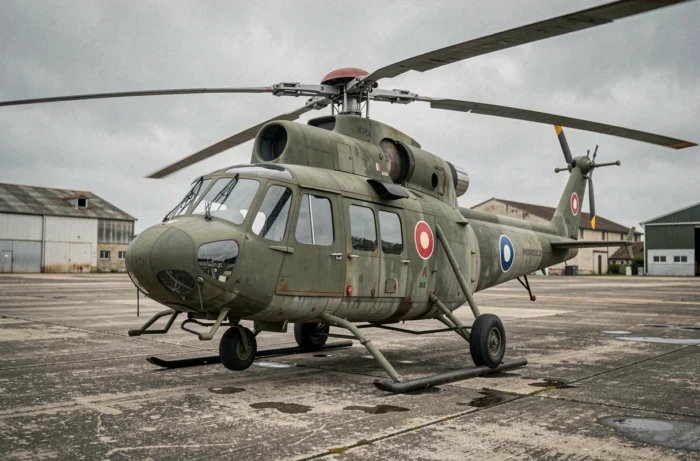
When a Puma is placed on a makeshift landing zone in sub-Saharan Africa, the question is not whether the aircraft is modern. It is whether it starts, whether it carries the intended load, and whether the crew has the sensors to land at night. This ground reality has shaped every step of the French military helicopter, from Indochina to current external operations.
First combat flights in Indochina and Algeria: the birth of a French doctrine
The helicopter does not enter French military history through the front door. Its first missions are limited to resupplying isolated posts and medical evacuations of the wounded, what operational personnel call MEDEVAC. In Indochina, the available aircraft are few, fragile, and their payload capacity remains low.
It is in Algeria that the shift occurs. The helicopter moves from logistical support to direct combat intervention. French forces develop troop airlifting to conduct rapid encirclement operations in mountainous or forested areas. The aircraft is no longer a medical taxi; it becomes a tactical vector. Fire support is experimented with, machine guns are adapted to civilian airframes, improvisation is key.
Tracing the evolution of the French military helicopter requires acknowledging this point: the employment doctrine preceded the technology. Algerian crews articulated needs that the industry took years to meet. Tactical thinking around rotary wings was born on the ground, not in design offices.
Gazelle and Puma: aircraft designed for the field, not for the airshow
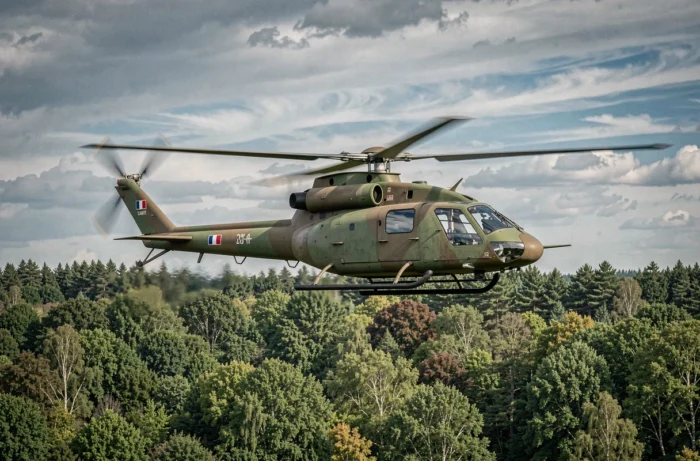
The generation of helicopters that equips the Army from the 1970s is based on two pillars: the Gazelle and the Puma. These aircraft are not high-tech marvels comparable to what the United States produces at the same time. Their strength lies elsewhere.
The Gazelle excels in armed reconnaissance and anti-tank support. Lightweight and maneuverable, it weaves through the terrain. The Puma, on the other hand, ensures maneuver: section transport, evacuation, resupply. Together, they cover the spectrum of missions that the Army Light Aviation (ALAT) conducts in external operations, from Chad to Lebanon.
What characterizes this period is the versatility imposed by budgets. There are no specialized fleets for each mission. The same Puma is used to drop commandos at night and to evacuate civilians the next day. Mechanics adapt, improvise, maintain airframes that accumulate flight hours well beyond initial forecasts.
The Tiger: the first combat helicopter designed as a weapon system
The arrival of the Tiger marks a clear break. For the first time, the French Army has a helicopter designed from the outset for combat, with integrated sensors, armor, and the ability to fire accurately at a distance. The Tiger is no longer an aircraft adapted for combat; it was born for it.
On the ground, particularly in the Sahel, the Tiger demonstrates its ability to operate at night, engage targets with guided missiles and rockets, and coordinate its strikes with ground troops. Feedback varies on the technical availability of the aircraft, but its operational value in fire support is not disputed by the deployed units.
NH90 Caïman and special forces: standardizing to gain responsiveness
The current trend is towards standardizing the fleet. The NH90 Caïman illustrates this logic. According to the Ministry of the Armed Forces, it is set to completely replace the helicopter component of the 4th Special Forces Helicopter Regiment starting in September 2026. We are moving from a heterogeneous fleet, composed of aging aircraft with disparate characteristics, to a more homogeneous fleet.
- Increased interoperability: having the same type of aircraft for multiple missions reduces logistical complexity and facilitates crew training.
- Improved projection capability: the Caïman offers a greater range and payload than the aircraft it replaces.
- Streamlined maintenance: fewer types of aircraft in service means fewer supply chains to manage in operational theaters.
For special forces, this transition changes the game. Operations are no longer planned by asking which aircraft will be available. We know what we have, we understand its limits, and we adapt the mission accordingly.
H160M Guépard Program: the joint helicopter and evolving avionics
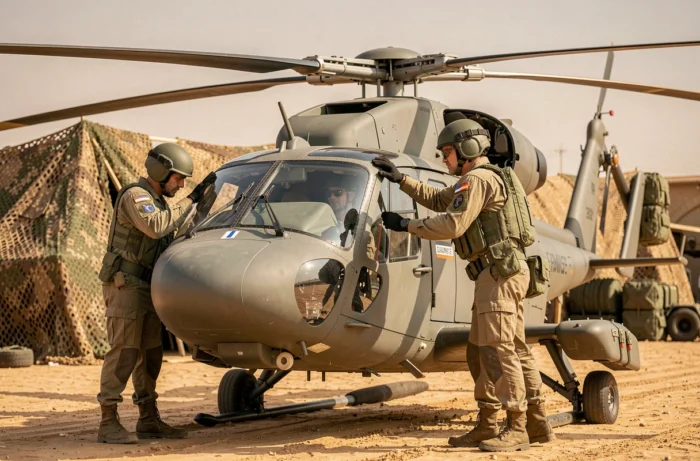
The H160M Guépard program takes this logic even further. Intended for the three armed forces, it is set to start equipping the Army by 2030. Its architecture is based on a principle that changes the way a military helicopter is conceived: open avionics allow for software updates without redesigning the aircraft.
Specifically, the Flyt’X system integrated into the Guépard is designed to accommodate new applications over time. A more efficient sensor, a next-generation data link, an updated navigation algorithm: all of this integrates without sending the aircraft back to the factory for months.
The acceleration of technological cycles as an operational constraint
This approach responds to a realization drawn from recent conflicts. Sensors, software, and data links evolve much faster than helicopter airframes. An aircraft delivered with the avionics of its design is already partially obsolete on the day it enters service. The DGA is experimenting with reduced integration times to quickly adapt existing equipment to current threats.
France is thus moving from a logic of fixed platforms, designed to last decades without major modifications, to scalable systems. We no longer replace a helicopter because its airframe is worn out, but because its architecture can no longer support the necessary updates.
The French military helicopter has always been shaped by the constraints of the field before those of engineering. From the first airlift operations in Algeria to the future software updates of the Guépard, the common thread remains the same: adapting the tool to the needs of those who use it under fire, not the other way around.