A 10-meter pool with Roman steps and a gently sloping floor isn’t cleaned the same way as a rectangular 4-meter above-ground pool. The pool’s layout determines almost everything: the robot’s navigation pattern, its ability to climb the walls, and the cycle time needed for complete coverage. Assessing the power, coverage, and efficiency of a modern pool robot starts with understanding how pools differ.
Battery repairability: what the EU regulation means for pool robots
People often talk about suction power or filtration fineness. Less often do they discuss what happens when a cordless robot’s battery starts to wear out after two or three seasons.
Starting February 18, 2027, the EU Batteries Regulation will introduce requirements for the removal and replacement of portable batteries. The European Commission notes, however, that an exception may apply to devices designed to operate in wet environments: in that case, the battery may only be replaceable by an independent professional.
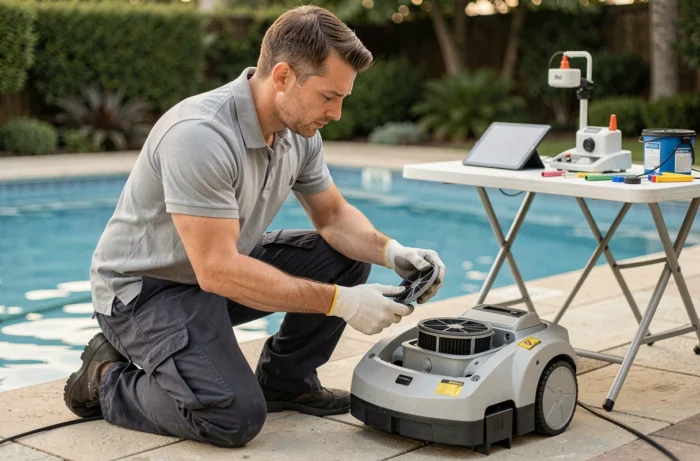
For pool owners, the implications are clear. Before buying a cordless robot, check the manufacturer’s battery replacement terms. Some models must be sent back to a service center, while others can be serviced by a local repairer. The cost and turnaround time of this work matter just as much as the initial purchase price when assessing the appliance’s actual lifespan.
When comparing the performance of modern pool robots, repairability should rank alongside battery life and cleaning power. A high-performance robot that can’t be repaired after two years isn’t a good investment.
Advertised battery life versus actual coverage: the spec-sheet trap
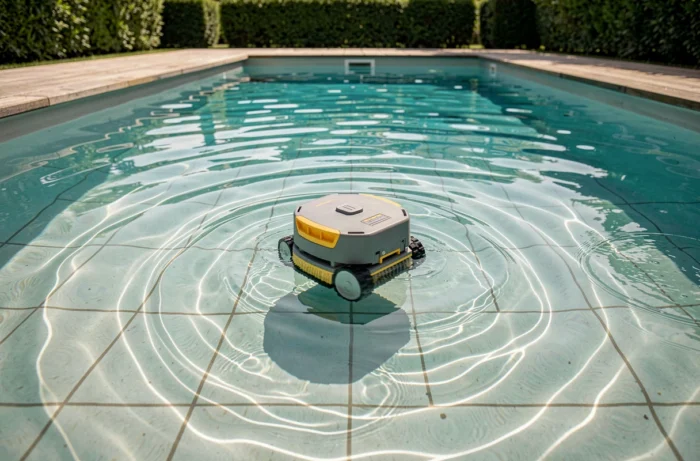
A robot advertised with three hours of battery life doesn’t necessarily clean better than one rated for two. Battery life alone, measured in hours, says nothing about how much of the pool gets covered in a single cycle.
Floor, walls, waterline: different areas require different cleaning
Most electric robots prioritize cleaning the pool floor. Walls require a different kind of traction (grippy tracks, rollers, or turbines that hold the robot against the surface). The waterline, where greasy deposits tend to build up, needs a dedicated cleaning pass that not all models offer.
A recent comparison of the Beatbot Sora 70 and the AquaSense 2 Pro illustrates this trade-off: their battery life and performance vary depending on the area and cleaning mode. Comparing the coverage achieved in a complete cycle gives a more reliable picture than the runtime stated on the packaging.
Recharging and multiple cycles
A single cycle isn’t always enough for a large pool. The robot then needs to recharge before resuming. Recharge time (often longer than the cleaning cycle itself) can significantly extend the total cleaning time. For a large or complex-shaped pool, a corded model has the advantage of running continuously without interruption.
Mapping or random navigation: the real impact on cleaning
Pool robots generally use one of two navigation approaches: random movement or smart mapping (using a gyroscope, accelerometer, and sometimes a camera).
A robot with random navigation can clean a simple rectangular pool satisfactorily, provided the cycle is long enough for overlapping passes to eventually cover the entire surface. But once you add steps, a swim-out bench, an L-shaped layout, or an uneven floor, more and more areas can be missed.
Models with mapping optimize their routes to reduce redundant passes. The benefits are most noticeable in large or complex-shaped pools, where a randomly navigating robot may leave strips untouched after a full cycle.
- Small rectangular pool: random navigation is usually sufficient, and these models cost less.
- Pool with steps, a submerged sun shelf, or a freeform shape: mapping reduces missed areas and shortens cleaning time.
- Large pool: mapping avoids the need for multiple cycles by optimizing each pass, saving energy and reducing brush wear.
Filtration and suction power: what really matters day to day
Filtration fineness varies from one robot to another. Mid-range and high-end models offer filter baskets that can trap fine particles (sand, pollen), while entry-level models are limited to visible debris (leaves, insects).
Filter basket capacity is often overlooked. A large-capacity basket can clean an entire pool without needing to be emptied mid-cycle. High-end models typically offer capacities of four to five liters, so there’s no need to empty the filter halfway through.
Suction power and pool surface
Suction power can’t be judged in isolation. A flexible liner can’t withstand the same level of adhesion as tile or painted concrete. Some manufacturers offer brushes suited to different pool surfaces (foam for liners, bristles for tile). Using the wrong brush reduces cleaning effectiveness and can damage the surface over time.
- Liner: choose soft foam brushes and moderate suction to prevent tiny tears.
- Tile or mosaic: use bristle brushes and strong suction to dislodge algae embedded in the grout.
- Concrete or render: use combination brushes (bristles and blades) designed to handle rough surfaces.
Corded or cordless: the choice depends on the pool
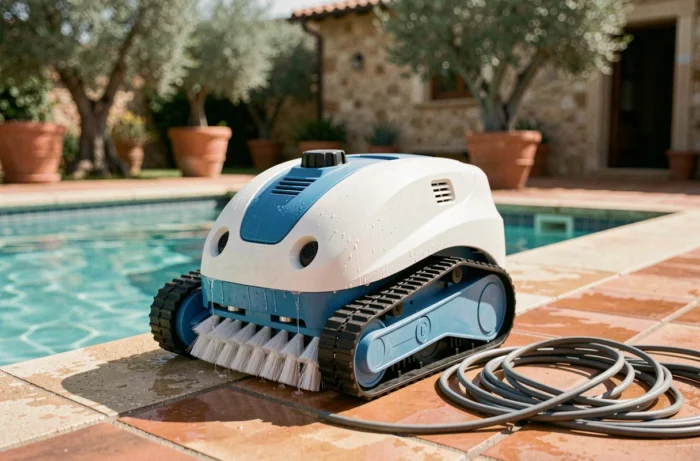
Cordless models are appealing because they’re easy to use. Put the robot in the water, let it work, then take it out. There’s no cable to unwind and no risk of it getting tangled around a ladder.
But corded models have practical advantages. The cable provides continuous power to the robot, eliminating concerns about battery life. That’s a major benefit for a large pool. A cable also allows for more consistent suction power, without the gradual drop-off caused by a discharging battery.
The choice between the two depends less on personal preference than on pool size and how often you want to clean it. For automated daily maintenance of a small above-ground pool, a cordless model makes life easier. For a large in-ground pool where the walls and waterline also need cleaning, a corded model remains the most reliable choice over time.
In recent years, the growing sophistication of pool robots has blurred the lines: mapping, mobile apps, and multiple cleaning modes. When choosing a model, going back to basics (actual coverage in one cycle, compatibility with the pool surface, and battery replacement terms) is still the surest way to invest in a device that will last for several seasons.