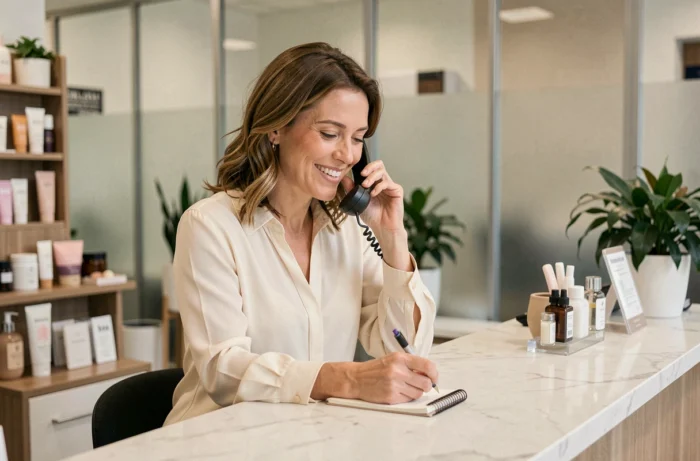
Beauty salons in France receive calls, messages and social media enquiries every day. The number of contact channels has grown with online booking, instant messaging and website forms. This variety makes it easier to book appointments, but it can also make it harder to get a quick answer when a request falls outside the usual scope: the price of a specific treatment, a contraindication, the cancellation policy or the availability of a particular beauty therapist.
Written message or phone call: which channel for which type of enquiry?
Most booking platforms (Planity, EasyWeek, Kalendes) let you reserve a time slot without direct interaction. For a standard treatment—hair removal, a facial or makeup—online booking is generally enough.
The situation changes as soon as your request calls for a personalised response. In that case, a written message (email, contact form, Instagram or Facebook message) works better than a phone call. The reason is simple: a clear message avoids repeated phone calls.
To make an effective written enquiry, include these four details so the salon can reply without needing to follow up:
- The treatment you are looking for, including the area or duration if it affects the price (for example, “half-leg hair removal” rather than simply “hair removal”)
- Your availability during the week, so the salon can suggest a time without further back-and-forth
- The specific question you need answered: price, appointment length, products used or any preparation required
- Any relevant health information, such as allergies, pregnancy or ongoing dermatological treatment, that could affect the procedure or be a contraindication
A phone call is still preferable in an emergency (a last-minute cancellation or running late) or when your request requires a real-time conversation with the beauty therapist. Otherwise, the contact details for Break Beauté illustrate the approach taken by many salons: bringing the phone number, address and contact form together on one page so clients can choose how to get in touch.
Cancellation terms and payment: what to ask before booking
Terms and conditions vary from one salon to another. Some establishments require full payment at the time of booking, others ask for a deposit, while some do not charge anything before the appointment. There is no single rule that applies across the industry.
For example, Institut La Dolce Vita requires full payment at the time of booking under its terms and conditions and sets out detailed cancellation terms. This policy is not representative of all salons, but it shows why it is worth checking these details every time.
What to clarify before confirming an appointment
Three questions can help you avoid unpleasant surprises. The cancellation notice period for avoiding a fee (24 hours, 48 hours or another period) is rarely shown on booking platforms. The accepted payment methods (card, cash or gift voucher) can also cause problems if you have not checked in advance.
Keep your booking confirmation, whether it arrives by email or text message. This document serves as proof in the event of a dispute over prepayment or cancellation. If the salon does not send written confirmation, ask for it explicitly.
Assessing a beauty salon remotely: looking beyond online reviews
Google reviews and ratings on booking platforms offer an initial indication, but they have well-known limitations. Reviews tend to focus on the welcome and atmosphere, and rarely cover hygiene or the technical quality of treatments. The quality of a hair removal procedure or anti-wrinkle treatment cannot be captured by a five-star rating.
Two things you can check remotely provide more useful information:
- A detailed treatment menu on the website, with durations and prices, suggests that the salon has a well-structured offering and makes it easier to compare options
- How quickly the salon responds to messages offers a glimpse into its day-to-day operations: a salon that replies within a few hours on weekdays probably manages its appointments better than one that leaves enquiries unanswered for several days
- Photos of the premises posted by the salon itself (not just by clients) can help you assess the condition of the equipment and whether hygiene standards appear to be followed

The first interaction as an indicator of quality
The response to your first enquiry is a real-world test. A beauty therapist who asks about your skin type, skincare habits or expectations before recommending a treatment plan demonstrates a level of professionalism that online reviews cannot measure.
By contrast, a generic reply that ignores the specifics of your request (copying and pasting the treatment menu or directing you to online booking without answering your question) may indicate limited availability or a high client volume that makes personalised support difficult.
Telemarketing and unwanted solicitations: what the law says
Unsolicited telemarketing remains an active issue in France. The Bloctel scheme and the penalties set out in regulations are intended to curb these practices.
If you receive promotional calls or text messages from a salon you have never contacted, you can report them via Signal Conso or to the CNIL. Consumers must give their prior consent to any commercial solicitation, whether by phone or text message.
This is separate from your relationship with a salon you already visit. An appointment reminder or promotional offer notification from an establishment where you have already booked is part of an existing commercial relationship, not unsolicited telemarketing.
The most reliable way to contact a salon is through the channel listed on its own website: a direct phone number, contact form or messaging service. Using an official channel reduces the risk of reaching an intermediary or a premium-rate number listed by a third-party directory.