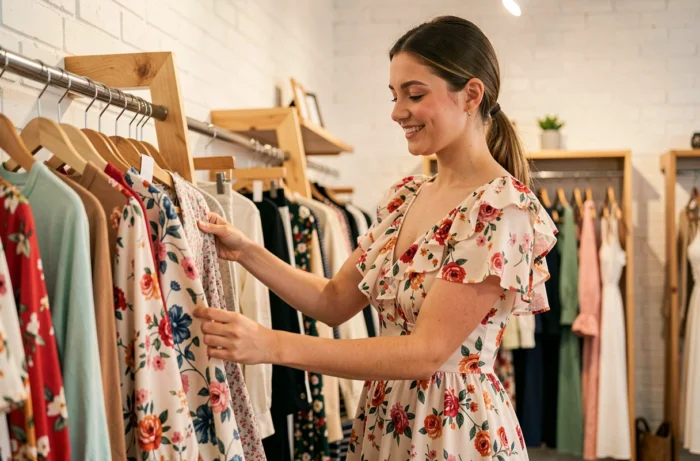
FB Sister generates measurable excitement among those under 25, but the reasons for this adherence go beyond mere trend effects. The brand, integrated into the portfolio of the German retailer NEW YORKER, occupies a precise stylistic niche: Y2K blended with streetwear, at prices that remain below the luxury radar. Understanding this positioning requires looking at the structure of the offering, the distribution model, and the limits that this system imposes.
FB Sister Compared to Other Internal Brands of NEW YORKER
FB Sister does not exist in isolation. It is part of an ecosystem of proprietary brands managed by NEW YORKER, alongside FSBN, SMOG, AMISU, and CENSORED. Each targets a different segment of the young customer base.
| Brand | Main Positioning | Target |
|---|---|---|
| FB Sister | Y2K, women’s streetwear, cropped cuts | Women aged 15-25 |
| AMISU | Women’s basics, classic cuts | Women aged 20-30 |
| FSBN | Men’s streetwear, casual | Men aged 15-25 |
| SMOG | Urban casual, workwear | Men aged 20-30 |
| CENSORED | Graphic, pop culture references | Mixed, aged 15-25 |
This table highlights a point that competitors rarely address: FB Sister occupies the only women’s Y2K niche in the portfolio. It does not compete against its sister brands for the same audience. This internal segmentation ensures a clear visual identity in NEW YORKER stores, without cannibalization.
A detailed article on the FB Sister brand on Fashion Stores discusses the stylistic codes that distinguish this line from other labels in the group.
Physical Distribution and In-Store Discovery Strategy

The FB Sister model relies heavily on physical retail. In France, the brand is distributed in NEW YORKER stores, with a presence in over fifty points of sale according to available data. This dependence on physical stores is not accidental: it is part of the strategy.
In-store, customers can touch the materials, try on cropped or wide-leg cuts, and most importantly, create complete looks on the spot. Matching sets, for example (coordinated top and bottom), make perfect sense when they can be tried on. The Autumn 2026 collection illustrates this logic with pieces designed to be paired:
- Mini skirts and wide-leg denim pants, intended to be worn with cropped tops or oversized hoodies
- Faux fur jackets, bombers, and varsity cuts that add volume to simple silhouettes
- Matching sets with striking prints, embroidery, and sporty details, sold as ready-to-wear ensembles
The in-store shopping experience encourages impulse buying and customer loyalty. A customer coming in for a top often leaves with a matching jacket. This mechanism works even better as prices remain accessible: in the second-hand market, FB Sister pieces resell for between five and nine euros, indicating the initial purchase price.
Color Palette and Y2K Codes: What the Autumn 2026 Collection Reveals
The Autumn 2026 collection from FB Sister covers a palette ranging from cream, gray, brown, and navy to camouflage, berry tones, and soft pastels. This spectrum is not trivial. It reflects a style strategy that focuses on layering pieces with complementary tones rather than isolated saturated colors.
The Y2K version of FB Sister emphasizes contrasts in materials and cuts, not loud colors. Relaxed silhouettes meet sporty details or preppy touches (blazers, shirts, polo collars). This mix allows customers to navigate between several styles without changing their wardrobe.

However, the brand does not offer a premium line or collaborations with external designers. While competitors like H&M or Zara multiply signed capsules, FB Sister maintains a consistent stylistic identity from season to season. This stability reassures a young clientele that returns looking for the same type of pieces with variations in colors and patterns.
Environmental Transition: A Documented Blind Spot
The appeal of FB Sister cannot be analyzed without mentioning sustainability issues. In September 2026, the organization Stand.earth identified NEW YORKER among the companies with the most significant gaps in supporting a responsible energy transition in Bangladesh.
This data concerns the entire group, not just FB Sister. NEW YORKER’s supply chain remains opaque regarding its climate commitments. For a young customer base increasingly aware of environmental issues, this gap between the brand’s trendy image and its production practices represents a tension that could weigh heavily in the medium term.
The second-hand model surrounding FB Sister, visible on resale platforms, partially mitigates this problem. Pieces circulate, are resold, and extend their lifespan. The question remains whether this spontaneous circular economy compensates for the lack of a structured environmental policy on the manufacturer’s side.
FB Sister appeals with a very targeted stylistic positioning, low prices, and a physical distribution that encourages discovery. The Stand.earth report reminds us that this model is built on industrial foundations that the next generation of customers may find insufficient.