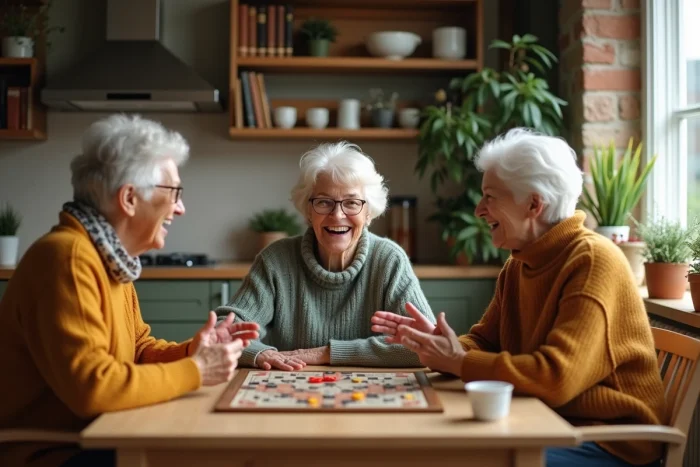
A neighbor stopping by for coffee, a card game on Thursday afternoon, a video call with a grandson: these moments may seem trivial, but they form the foundation of well-being after 60. When opportunities for contact become scarce, physical and mental health decline rapidly. Promoting exchange and social connections among seniors requires understanding what hinders meetings, and then implementing concrete solutions tailored to each situation.
Intergenerational cafés and community lounges: game-changing formats
Have you noticed that a simple regular meeting place is enough to transform the social life of a neighborhood? This is the principle behind municipal intergenerational cafés, the number of which has significantly increased in France since the Autonomy Law 2025. This decree (n°2025-347 of April 15, 2025) has subsidized the opening of over 500 spaces of this type, designed to encourage spontaneous exchanges between generations.
The operation is simple. An association or municipal space opens its doors at fixed hours. You can find a hot drink, sometimes a board game, and, above all, other people. No need to register or pay a membership fee. The informal setting removes the main barrier: the fear of not fitting in.
Online platforms also facilitate connections. On partage-senior.net, seniors find shared activities and discussion groups organized by interests, making the first step toward a richer social life easier.
In Japan, elderly residences incorporate community lounges where participation is encouraged by default. According to an OECD report on active aging published in November 2025, these models show greater resilience of social ties in the face of extreme longevity. Several European pilot projects draw inspiration from them.
Life story workshops: stimulating memory and creating bonds
A lesser-known format deserves attention: shared memory clubs. The principle is to gather a small group of seniors around their memories. Each person shares an episode from their life, while the others listen, ask questions, and engage.
The effect on mental health is documented. A study by ANESM published in January 2026 reports a notable decrease in depression among regular participants. Retention has increased since 2024 due to the integration of digital tools that automatically transcribe stories, allowing seniors to keep a written record of their history.
This type of workshop works well both at home and in collective settings. Three elements explain its effectiveness:
- Active listening among peers creates a sense of recognition that family relationships, often asymmetrical, do not always provide.
- Sharing personal experiences engages episodic memory, which constitutes regular cognitive exercise without appearing so.
- The group naturally bonds: participants return because they want to hear the continuation of others’ stories.
Digital tools for seniors: overcoming the divide without forcing
Offering a tablet to an 80-year-old is not enough. The tool does not create the connection; it extends it. The challenge lies in the initial support.
Since 2025, programs like “Grandparents Go Digital” have been developing in France. Their method relies on a pairing: a young person (high school student, college student) trains a senior in using a video tool, usually over three or four sessions. The report from the Fondation de France on aging and digital technology, published in March 2026, emphasizes that these initiatives significantly reduce rural isolation.
Why does this format work better than a group class at a media library? Because the human relationship precedes the technique. The senior does not learn to “use a tablet.” They learn to see their grandson on video, to send a photo of their garden, to join a discussion group on a topic they are passionate about. The concrete goal motivates learning.
Choosing the right tool according to the situation
For a person at home with limited mobility, next-generation teleassistance now integrates social functions: simplified video calls, reminders for group activities, neighborhood alerts. These services go beyond security and contribute to maintaining social ties on a daily basis.
For a mobile and autonomous senior, a smartphone with two or three well-configured applications covers most needs: family messaging, local activity calendar, access to a peer-sharing platform.
Group activities in rural areas: the transport challenge
In the city, opportunities for meeting exist. In rural areas, transport remains the primary obstacle to social connections for seniors. A person who no longer drives and lives fifteen minutes from the nearest store cannot reach a workshop or community café without external help.
Several solutions are developing at the local level:
- Community shuttles, funded by local communities, provide weekly rotations to collective activity locations.
- Solidarity carpooling among neighbors, sometimes organized through online groups, allows for shared trips without heavy formalities.
- Some associations directly move the activity: an organizer goes to a hamlet with materials (games, books, creative supplies) and gathers residents on-site.
Bringing the activity closer to the living area rather than the other way around radically changes the participation rate. Feedback from intergenerational cafés shows that geographical proximity takes precedence over the quality of the proposed program.
Maintaining social ties after 60 does not rely on a one-size-fits-all recipe. A life story workshop may suit an introverted person, a community café may appeal to someone who enjoys spontaneous contact, and a video tool may help a senior distant from their family. The main challenge remains to remove practical barriers, particularly transport and the handling of digital tools, so that every elderly person can choose the form of sociability that suits them.