The retrieval of funeral ashes at home raises questions that go beyond mere superstition. Between French legal framework, religious positions, and the psychological impact documented by grief professionals, the reasons why this practice is associated with domestic misfortune deserve to be examined one by one.
Emotional burden of ashes kept at home: what grief professionals say
Psychologist Josée Jacques pointed out that keeping an urn at home can slow down the grieving process. The mechanism is clear: the bereaved person maintains an almost living relationship with the deceased, through the urn, instead of reinvesting in new activities or relationships.
This observation is not based on superstition but on clinical findings. The permanent presence of the urn hinders reconstruction, sometimes for several years. The “misfortune” perceived by families finds a concrete explanation here: a stagnant grief generates anxiety, family conflicts, and social withdrawal.
Funeral networks in France and Quebec have reported in recent years an increase in requests from families wishing, long after the death, to place in a columbarium or scatter ashes kept at home. The reasons cited are recurrent: emotional burden has become unbearable, moving, or simply the realization that the presence of the urn weighed on the atmosphere of the home. You can learn more on Senior Cybernet about the beliefs and explanations surrounding this practice.
Funeral law and retrieval of ashes: a prohibition often ignored
The law of December 19, 2008, regarding funeral legislation established a clear principle: ashes must receive the same treatment as a body. Keeping an urn in one’s living room, on a shelf, or in a closet does not comply with this text.
| Legal options for ashes | Location | Accessible to relatives |
|---|---|---|
| Burial of the urn | Cemetery (grave or vault) | Yes, during cemetery hours |
| Placement in a columbarium | Cemetery or cremation site | Yes |
| Scattering in nature | Outside public roads, with declaration at the town hall | No (unmarked location) |
| Scattering in the memory garden | Cemetery | Yes |
| Keeping at home | Private home | Restricted to the occupant |
The last line of the table is the problematic one. Funeral legislation aims to prevent several documented abuses:
- The urn being lost, broken, or stored in an attic out of negligence over the years
- The sharing of ashes among several family members, which undermines the integrity of the deceased
- Family disputes over who “holds” the remains, a recurring conflict factor reported by funeral operators
The 2008 text does not provide for any specific criminal sanction for keeping ashes at home. The lack of oversight makes the prohibition difficult to enforce, which explains why many families still keep urns at home, either unknowingly or knowingly.
Catholic Church’s position on ashes at home
The Vatican instruction Ad resurgendum cum Christo, published in 2016, explicitly prohibits Catholics from keeping ashes at home, scattering them, or transforming them into objects (jewelry, diamonds). The theological reason is linked to the faith in resurrection: the remains must rest in a sacred place, accessible to the community of believers.
Several European episcopal conferences have tightened these directives between 2023 and 2024, targeting recent commercial abuses. The transformation of ashes into jewelry or synthetic diamonds, their dissemination on social media as “digital memorials,” are now explicitly identified as violations of the dignity of the deceased in revised pastoral guidelines.
For practicing Catholic families, retrieving ashes at home therefore goes against a formal religious prohibition. The notion of “misfortune” takes on a spiritual dimension here: it is not a curse but an act considered contrary to the respect owed to the deceased and the community.
Domestic superstitions and funeral ashes: origins of beliefs
Beyond the legal and religious framework, popular beliefs associate the presence of ashes in a home with negative phenomena. These superstitions vary by culture but share a common foundation: human remains in a domestic space disturb the balance of the household.
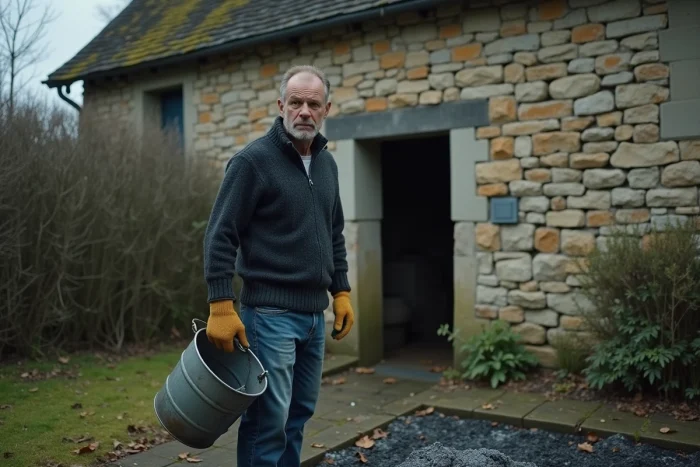
In some Asian traditions, particularly Buddhist, the prolonged keeping of ashes at home is discouraged. The idea is that the spirit of the deceased remains “attached” to the place instead of moving on. This belief has been mentioned in online Buddhist communities, where practitioners report that monks advise against this practice.
In France, superstition intertwines with psychological discomfort. An urn placed on the mantelpiece or in a living room alters the perception of space. Visitors may feel discomfort, and children may ask questions that adults struggle to answer. The home becomes a place of memory not chosen by all its occupants, creating latent tensions.
The line between superstition and psychological reality is thin. The “misfortune” associated with ashes at home often combines unresolved grief, an unknown legal framework, and inherited beliefs that together make cohabitation with an urn difficult to sustain over time. Families that ultimately choose to place the ashes in a columbarium or a memory garden frequently describe a tangible relief, as if the home regains its primary function as a living space.